Smoke (1995)
A 1995 American independent drama directed by Wayne Wang from an original story and screenplay by Paul Auster. The film was produced by Greg Johnson, Peter Newman, Kenzo Horikoshi, and Hisami Kuroiwa, and it was a co-production between the United States, Germany, and Japan, distributed in North America by Miramax. The cast is anchored by Harvey Keitel and William Hurt, with Stockard Channing, Harold Perrineau Jr., Giancarlo Esposito, Ashley Judd, and Forest Whitaker in supporting roles. The film is the first half of a paired Auster-Wang project; the loose companion piece Blue in the Face was released the same year and reuses the same Brooklyn cigar shop and many of the same cast members.
What the film does
The film is a series of interconnected vignettes that take place in and around a small Brooklyn cigar shop run by Augustus “Auggie” Wren. Auggie has been taking a single photograph of the shop from across the street at 8:00 a.m. every morning for years, and he has bound the photographs into thick albums that he keeps behind the counter. The shop is a port of call for a rotating cast of regulars: a recently widowed novelist named Paul Benjamin, a young Black man named Rashid who appears in the neighborhood with no clear story, a battered mother who comes in for cigarettes, a regular named Cyrus Cole who runs a gas station outside the city.
The film follows the slow gravitational pull of these characters toward Auggie’s counter. Paul is lost after his wife’s death, and Auggie’s photographs are the thing that pulls him back into the present tense: when Paul says the photos are “all the same,” Auggie tells him to look again, that each one is a different moment, and that the work of living is the work of slowing down enough to see the difference. The Auggie-Paul conversation in the back of the shop is the heart of the film, and Keitel and Hurt play it like two old friends who have only just met, with the kind of quiet mutual recognition that does not need to be explained.
Rashid’s storyline moves the film into a different register. Paul saves Rashid from being hit by a truck, takes him in, and discovers that Rashid is the estranged son of a man Paul once knew, the gas-station owner Cyrus. Rashid tracks his father down at the gas station, takes a job there under a false name, and is eventually identified. The Rashid-Cyrus reunion plays out at the gas station and is the film’s emotional climax, played in long takes with a restraint that lets the audience do most of the work.
The film ends back in the cigar shop, with the album of photographs on the counter and the regulars drifting in and out. The last image is a photograph, taken at 8:00 a.m., of the same shop, slightly different, slightly the same.
Why it’s in the canon
Criteria blend is 1+3, loved it and want to remember it. Smoke is a small, quiet film, and the things that make it work are easy to miss on a casual viewing. Wang and Auster hold the camera still for long stretches, and the dialogue is mostly people talking to each other in small rooms, and there is no music in many of the scenes, and the plot is mostly characters figuring out how to be in the same room as each other. None of this is a marketable pitch. It is also the reason the film has stayed in the canon for thirty years.
Keitel’s Auggie is the main reason to watch the film, and it is one of the great unsung character creations of the 1990s. Auggie is a man who has made a private ritual out of paying attention, and the photography project is the external form of a discipline that most people never get around to starting. The famous monologue, where Auggie explains the photos to Paul and tells him to slow down, is the kind of scene that a less disciplined film would ruin with music and reaction shots, and Wang and Keitel play it straight. Hurt’s Paul is the other half of the film, and Hurt brings a grief to the role that makes the slow-motion recovery in the cigar shop feel earned rather than sentimental.
The supporting cast is uniformly good, and the film gets real work out of actors who are usually in much bigger movies. Esposito and Perrineau play the Rashid storyline with a discipline that keeps the father-son reunion from tipping into melodrama. Judd has a small early role as a woman who turns up at the counter with a story she has been saving. The film does not waste any of them.
Smoke is a dvd-era film in the most literal sense: it was released in 1995, grossed $38 million on a $7 million budget, and the audience that found it on home video in the late 1990s and early 2000s is the audience that has stayed with it. The Miramax DVD was a fixture of the indie-rental era, and the film is the kind of thing that a person either has on a shelf or has been meaning to pick up. The dvd in the collection is the Miramax single-disc release.
A note on the image
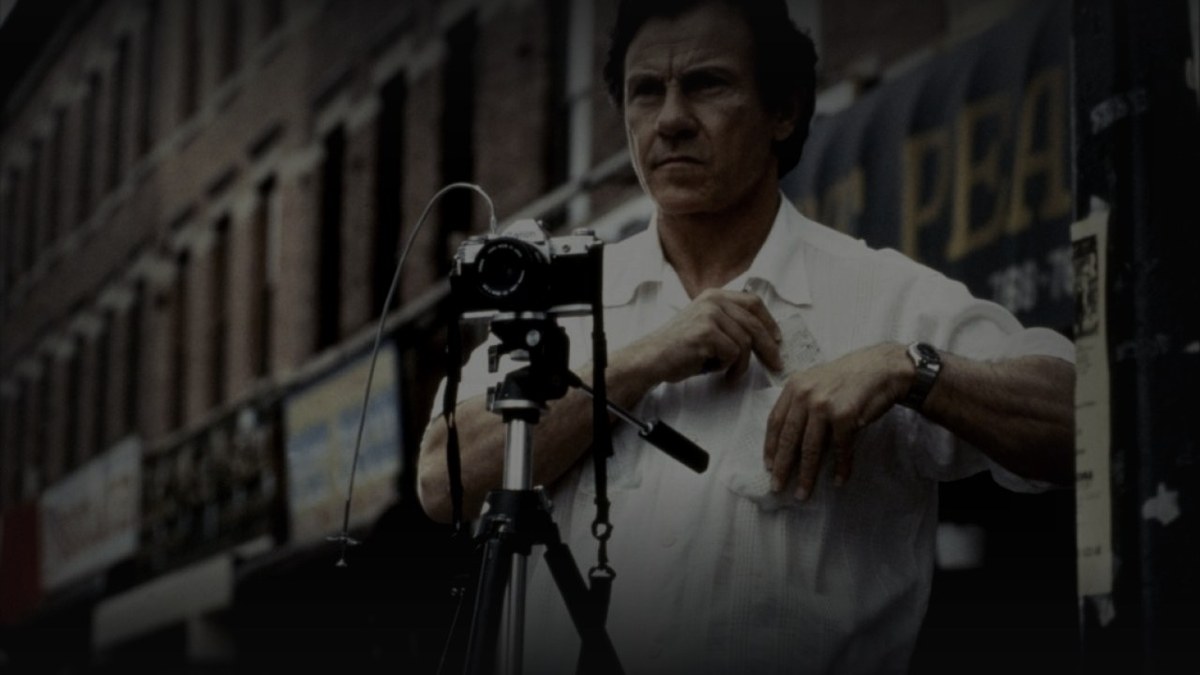
The hero image is the film’s most iconic single shot: Harvey Keitel as Auggie Wren, on a Brooklyn sidewalk with a 35mm camera on a tripod, the cigar shop and its painted signage behind him, and the morning light flat against the brownstone across the street. It is the composition that runs through most of the film’s promotional material and through the cover of the Auster script collection that paired Smoke with Blue in the Face. The source came from a Yandex image search via the MUBI CDN, in a 1280x720 frame. The image was downsized via Lanczos to exactly 1200x675 to match the rest of the canon, then baked at factor 0.45 to output brightness 35.3, within the daylight range.
On hand
Yes, dvd. No digital or download. A Miramax single-disc dvd release, a dvd-era pickup.
image: 16:9 still sourced via yandex from the mubi cdn (1280x720), downsized via lanczos to 1200x675, baked through scripts/bake_dark_photo.py at default factor 0.45, output brightness 35.3