187 (1997)
A 1997 American crime drama thriller directed by Kevin Reynolds and written by Scott Yagemann, who based the screenplay on seven years of substitute-teaching experience in the Los Angeles Unified School District. The film stars Samuel L. Jackson as Trevor Garfield, a Brooklyn science teacher who survives a student stabbing, relocates to the San Fernando Valley, and runs into gang trouble at his new school. It also stars John Heard, Kelly Rowan, and Clifton Collins Jr. The film’s title is the California Penal Code section that defines murder; the writers claim 90% of the film’s material is based on incidents that happened to Yagemann and other teachers in real life.
187 was produced by Icon Productions and released by Warner Bros. on July 30, 1997. It received mixed to negative reviews from critics and was a box-office bomb, grossing $5.7 million against a $20 million budget.
What the film does
Trevor Garfield is a Brooklyn high school science teacher. He gives Dennis Broadway, a gangster student, a failing grade. Dennis writes the number 187, the California police code for homicide, on every page of Trevor’s textbook and threatens to murder him. Trevor reports the threat to the administration, who ignore it. Dennis ambushes Trevor in the school hallway and stabs him in the back and side multiple times with a shiv.
Trevor survives and relocates fifteen months later to the San Fernando Valley, where he works as a substitute teacher. He is assigned to another class of unruly students, including a Chicano tag crew called the Kappin’ Off Suckers. The classroom becomes a battleground over a bag of stolen money the students believe Trevor has taken from one of their crew. The gang pressures Trevor by threatening a student named Rita, and eventually Rita is killed. Trevor takes the law into his own hands and confronts the gang, hiding a pistol in a cut-out copy of The Pocket Professor, a chemistry reference book.
The film’s final sequence is a corridor standoff. Trevor walks the empty school at night, finds the gang members responsible for Rita’s death, and kills them one by one. The final confrontation plays out in the chemistry stockroom. Trevor walks out of the school, the blood on his hands visible, and drives away. The film’s last image is the school security guard finding the gun Trevor left behind and deciding to keep it. The implication is that the cycle will continue, and that the violence is contagious.
Why it’s in the canon
Criteria blend is 1+3, loved it and want to remember it. 187 is the rare urban-school thriller that is also a genuinely effective thriller. Most films in the genre collapse into melodrama or moral lecture, and Reynolds and Yagemann manage to keep both halves in the frame at the same time. The classroom scenes feel like real classroom scenes, with the kind of low-stakes verbal sparring that substitute teachers actually have to handle. The classroom choreography is patient and observational. The violence, when it arrives, lands because the film did the work of establishing the human stakes.
Samuel L. Jackson, in his first top-billed starring role, gives Trevor a controlled fury that holds the film together. Trevor is the kind of character Jackson does better than anyone: a competent man pushed past his limits by a system that will not protect him. The supporting cast, particularly Clifton Collins Jr. as the lead gang member Cesar, sells the world of the students without stereotyping it. John Heard plays the cowardly principal, the administrative archetype the film is arguing against.
The film’s visual palette is the late-1990s Warner Bros. look: cool blue interiors, sodium-lamp exteriors, the occasional golden-hour shoot-out. Reynolds shoots the San Fernando Valley like the costner-rivers-penn school of liberal American drama, with the camera holding just long enough to let the audience see the cost of the violence on both sides. The film is also, inadvertently, a time-capsule of late-1990s Los Angeles: the cars, the schools, the music, the wardrobe. Watching it now is a reminder that the urban- school-thriller genre and the gangster-rapper era existed in the same news cycle, both telling the same story about the same generation of teenagers from different vantage points.
187 was a critical and commercial failure, and the script is the weakest part of the film. The dialogue is occasionally on-the-nose, and the film’s moral framework is more conservative than it lets on. But the film’s commitment to its premise, and Jackson’s performance, carry it through. The film earned a cult following on home video and cable, where it found the audience the theatrical release missed. The DVD is a relic of that audience.
A note on the image
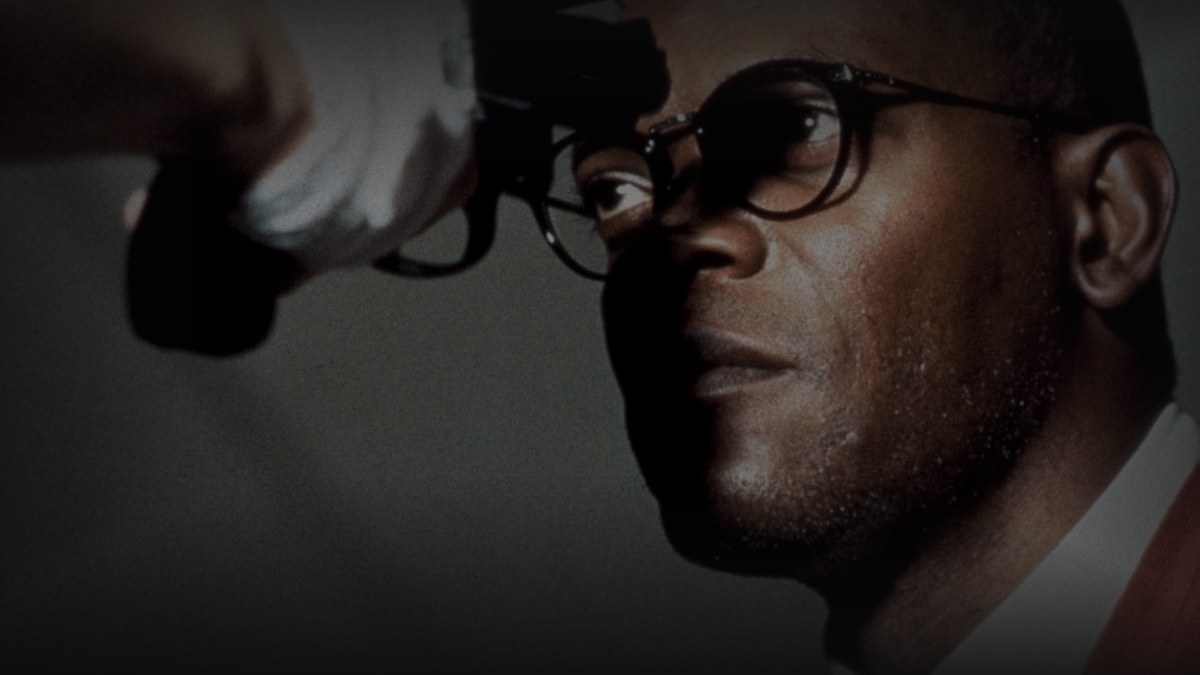
The hero image is a 16:9 still from the film showing the lead character under duress, the gun-and-glasses composition that ran across most of the film’s promotional material. The source came from a Yandex image search via the kinorium movie-shot endpoint, in a 1920x1080 frame. The image was downsized via Lanczos to exactly 1200x675 to match the rest of the canon, then baked at factor 0.45 to output brightness 33.5, within the daylight range.
On hand
Yes, DVD only. No digital or download. A late-1990s Warner Bros. DVD release picked up secondhand.
image: 16:9 still sourced via yandex from a kinorium movie shot (1920x1080), downsized via lanczos to 1200x675, baked through scripts/bake_dark_photo.py at default factor 0.45, output brightness 33.5